1 Year Diploma

Emergency Medical Technician

Train to respond to emergencies and provide critical pre-hospital care.
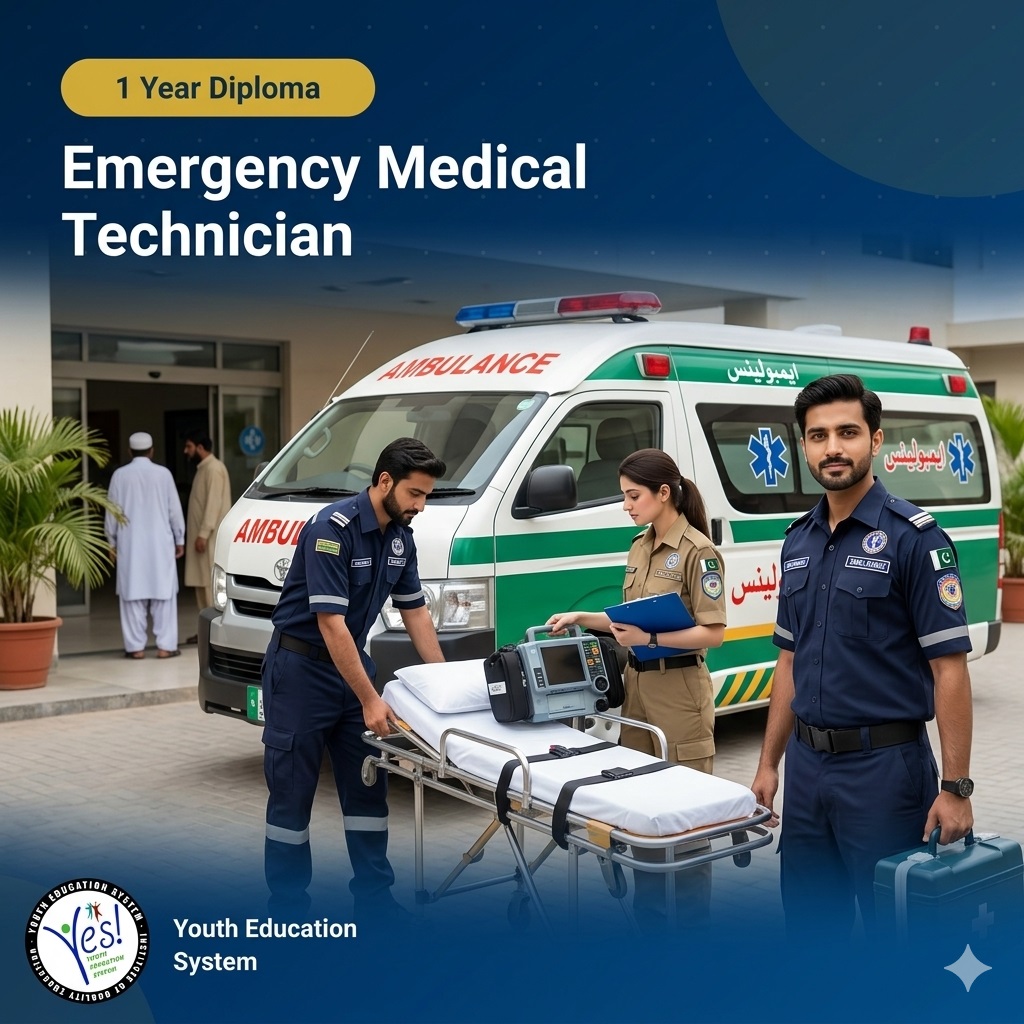
Emergency Medical Technician

Program Overview

Emergency Medical Technicians are the first trained people to reach a patient after an accident, a heart attack, a fall or a childbirth that cannot wait. They assess the situation, give urgent care at the scene, and move the patient to hospital safely while keeping the emergency department informed. The work is fast and demanding, and it depends on calm judgement as much as on technical skill.

The Emergency Medical Technician diploma at YES is a one year program that prepares students for this role. It begins with the basics of the human body and the principles of first aid, and then builds towards the skills used in real emergencies: checking a patient's airway, breathing and circulation, controlling bleeding, giving cardiopulmonary resuscitation (CPR), immobilising fractures and spinal injuries, and handling patients of every age.

A large part of the course is about decision making under pressure. Students learn how to make a scene safe before touching a patient, how to decide which patient in a group needs help first, how to lift and move someone without making an injury worse, and how to record and hand over information clearly to hospital staff. These habits matter as much as any single procedure.

The program is intended for students who want to work in ambulance services, hospital emergency departments and rescue teams, and who are comfortable in situations where things are urgent and unpredictable.

What You Will Learn

  • Human anatomy and physiology as they relate to emergencies
  • Scene safety, patient assessment and triage principles
  • Basic life support: airway management, oxygen delivery and CPR
  • Recording and interpreting vital signs: pulse, blood pressure, breathing rate, temperature and oxygen saturation
  • Bleeding control, wound care, dressing and bandaging
  • Splinting of fractures and spinal immobilisation
  • Care in common medical emergencies such as chest pain, breathing difficulty, seizures, stroke symptoms, diabetic emergencies and poisoning
  • Safe lifting, patient transfer and ambulance operations
  • Basic childbirth assistance and care of infants and children in emergencies
  • Communication, documentation and handover to hospital staff

Practical Training

Emergency care cannot be learned from a book alone, so practical sessions with mannequins, splints, stretchers and basic life support equipment form a core part of the training. Students repeat each skill until it becomes automatic, because in a real emergency there is no time to look up the steps.

Where Graduates Look for Work

Graduates typically look for work in settings where trained emergency responders are needed. Roles and requirements differ between employers, so it is worth speaking to them directly.

  • Ambulance services, both hospital-based and charitable or private
  • Emergency and casualty departments of hospitals and clinics
  • Rescue and emergency response organisations
  • Industrial sites, factories, construction projects and event medical teams
  • Sports clubs, schools and community first-aid roles

Who Is This Program For?

This program suits people who stay calm under pressure, are physically fit enough to lift and move patients with proper technique, and genuinely want to help people on the worst day of their lives. It is not a good fit for anyone who is uncomfortable with blood, injuries or working irregular hours.

Eligibility and Duration

Eligibility: Matric (Science) | Age limit 40 years
Duration: 1 Year Diploma

Frequently Asked Questions

Applicants need to meet the eligibility criteria: Matric (Science) | Age limit 40 years. If you are unsure whether your result or age qualifies, call our admissions team before you apply, because they can check your situation directly.

The program runs for 1 Year Diploma. Class timings and batch start dates depend on the campus and the number of admissions, so please confirm the current schedule with the admissions office.

No institute can honestly promise a job. A diploma gives you recognised training and practical skills, which employers look at along with your attitude, punctuality and experience. Students who treat their training as the start of a work record, and who keep learning after they finish, do best.

Our programs are run under YES's affiliation with the Sindh Board of Technical Education (SBTE). Please ask the admissions office for the current certificate and examination details for your batch, and read our Affiliation & Accreditations page, before you pay any fee.

You need to be reasonably fit, because the work involves lifting, carrying and standing for long periods. Correct technique matters more than raw strength, and it is taught during the practical sessions.
Interested in this Program?

Apply now and our admissions team will get in touch with you regarding fees, schedule, and seat availability.

Need Help?

admission@theyes.edu.pk

Other Programs You May Like